Financial literacy is technically part of the Canadian curriculum. But ask most parents whether their kids are actually learning it, and you'll get a very different answer.

Nelson engaging students and families at our Financial Literacy Skills Night, Jack Chambers Public School, London ON, May 2026
Last month, Nelson and I (Victoria), were invited to Jack Chambers Public School in London, Ontario to host a Financial Literacy Skills Night. The school had specifically sought out resources to bring financial literacy to life for their students and families. They knew the curriculum alone wasn't enough.
What happened that evening exceeded even our expectations!
The Gap Is Real, Even in Schools That Try
Here is something most Canadian parents don't know: financial literacy has been part of the Ontario math curriculum since 2020. Starting in 2026, it becomes a mandatory part of the Ontario Secondary School Diploma. Students will need to pass a financial literacy assessment to graduate.
So the intention is there and so is the policy. But the reality? When teachers are under pressure to complete the math curriculum, financial literacy is often the first thing that gets set aside. It is not because teachers don't care, instead the curriculum is packed and time runs short.
The gap between what we want for our kids and what they are actually being taught is significant. According to RBC's 2025 Talking Money With Our Kids Poll, many parents feel unequipped to fill it themselves. Not because they don't want to, but because they don't know where to start.
That is exactly the gap Jack Chambers decided to address, and why they brought us in.
If you are a Canadian parent ready to fill the skills gap for your kids, our resources were built for exactly this moment.
What Actually Happened That Night
Kids arrived with their families, some were excited and others not sure what to expect! But all of them left telling us exactly what they learned, and most of them wanted to know when they got to do this again.

Kids voting on wants vs needs, one of the most engaging moments of the night
The evening started with Nelson giving a presentation that was interactive. Kids were answering questions, participating in games, and holding up signs to vote on whether things were a want or a need. The audience worked together to identify prices and work on a budget, everyone involved and engaged.
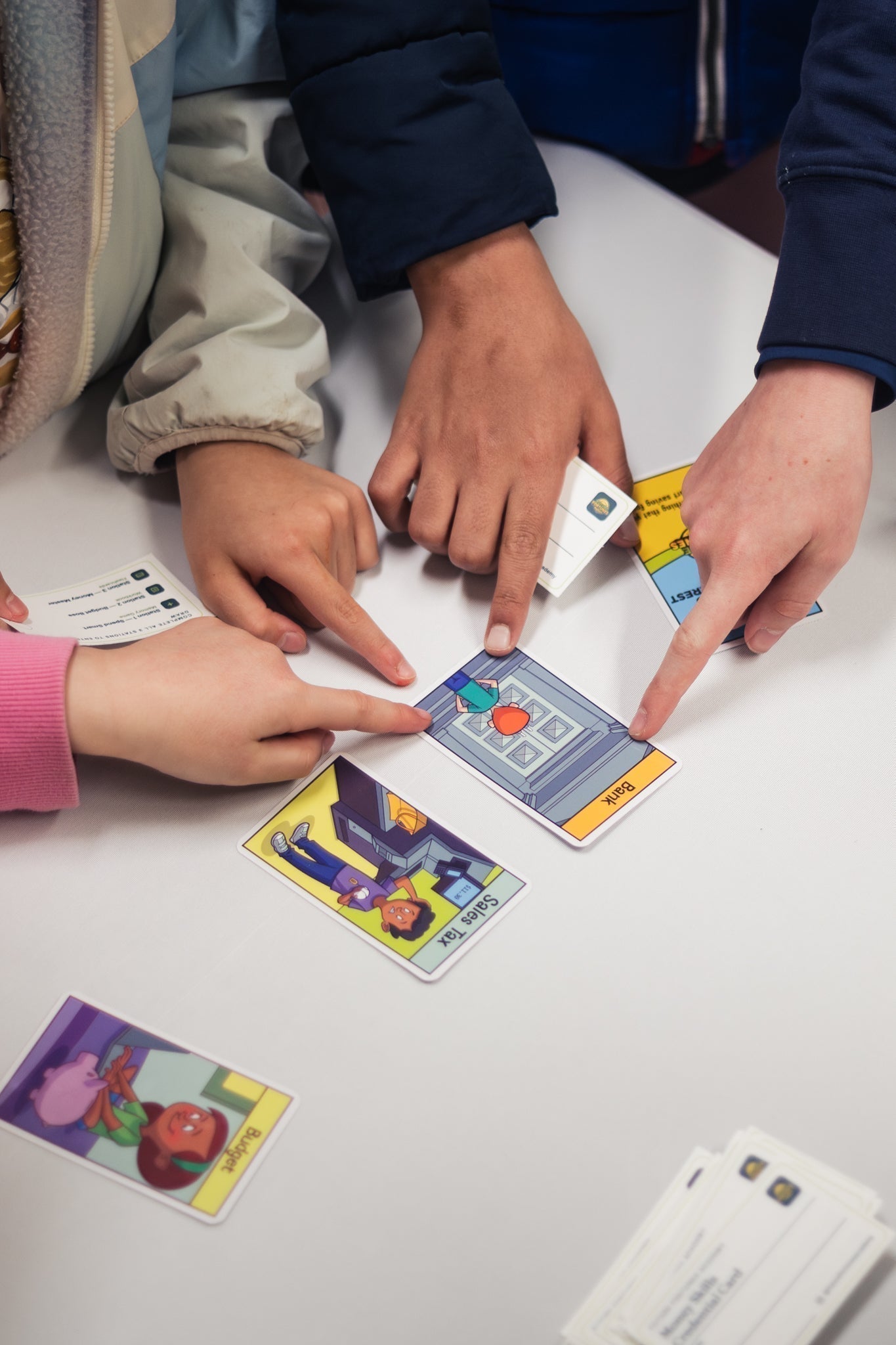
From there, families moved through three stations, each one built around one of our products:
Spend Smart. Kids used our Memory Game to match financial terms to their definitions through play.
Budget Boss. Families worked through exercises from our Workbook, exploring budgeting, debt, and earning.
Money Master. Our Flashcards sparked real conversations between parents and kids about financial concepts.
At the end of the night, kids guessed how much money was in a jar for a chance to win it, and gave us their feedback on the evening.
"I loved that we learned about needs and wants!" Mia, event attendee
"The stations of games were super fun!" Jack, event attendee
This was from a parent who reached out afterward:
"He didn't even want to leave, asking when the next one was."
Her son had spent the evening learning about budgeting, debt, and the difference between wants and needs. He left excited to apply this knowledge in his own life.

Kids at the stations, working through concepts using our flashcards, memory game and workbook
Want to recreate this kind of learning at home? Our products make it simple. No lesson plans, no prep, no finance degree required.
See the full collectionWhy Kids Actually Engaged
The secret wasn't a fancy curriculum. It was the format.
Kids learn about money best when it doesn't feel like a lesson. When they are playing a game, making decisions, debating with their friends about whether a video game is a want or a need, that is when it sticks. Research from PISA 2022 found that students who discuss saving and purchasing decisions with their parents at least once a month are significantly more financially literate. The opportunity to even have a conversation matters as much as the content.
That is what this evening created, a conversation between kids, between families, and between parents and their children in a way that felt completely natural.

Our Canadian financial literacy resources, including flashcards, memory game and workbook, in action at the event
So What Does This Mean for You at Home?
Most families won't have a Financial Literacy Night come to their school. (Although, reach out to us if you know your school would want to host one!) But the tools that made that evening work are available to every Canadian family right now.
You don't need a finance degree. You don't need to sit your kid down for a formal lesson. You need a starting point, something that opens the conversation in a way that feels natural and age-appropriate for kids aged 8 to 14.
Here is where to start based on your family:
If you have 10 minutes and a busy household
Start with our Financial Literacy Flashcards. Each card has a term on the front and a definition plus a conversation prompt on the back. No prep required. Pick one up at dinner, in the car, or before bed. The conversation starts itself.
If you homeschool or want structured learning
Our Workbook takes all 52 financial concepts deeper, covering personal finances, budgeting, earning, entrepreneurship, and growing your money. It fits naturally into a structured learning day and gives kids something to work through at their own pace.
If you want to make it fun
Start with the Memory Game. Kids match 24 financial terms to their definitions through play. It works as a family game night activity, a rainy day activity, or exactly the way we used it at Jack Chambers. It was a station kids didn't want to leave.

The complete Future Fortunes Academy collection, built for Canadian kids aged 8 to 14
Ready to start the money conversation?
Shop our complete Canadian financial literacy collection for kids aged 8 to 14. Free shipping across Canada.
Shop nowThe Bigger Picture
Jack Chambers did something that took courage. They acknowledged a gap and went looking for something to fill it. Not every school will do that. Which means for most kids, the financial education they get at home is the one that shapes how they handle money for the rest of their lives.
That is a big responsibility. But it doesn't have to be a heavy one.
Start small. Start with one conversation. Start with a card, a game, a question at the dinner table. The kids in that room at Jack Chambers proved something we already believed. When you give kids the right tools, they are ready to learn. More than ready actually and they are excited about it.
And that excitement is yours to spark at home. We built the tools to help you do it.
Give your kids the tools to start learning about money
Canadian-made resources for kids aged 8 to 14. No finance degree required. Free shipping across Canada.
Shop the full collection
Share:
Saving Money Isn't the Lesson Your Kid Needs
Canada Child Benefit Increase Will Come and Go Unless You Do This One Thing